Structure
This page was downloaded from the Occupational Performance Model (Australia) [OPM(A)] website (www.occupationalperformance.com) re-launched in 2006. It contains a reprint of the seminal article that described the major constructs of the model and the relationship between these constructs. The original publication details are as follows:
Chapparo, C., & Ranka, J. (1997). Occupational Performance Model (Australia): A description of constructs and structure. In C. Chapparo & J. Ranka (Eds). Occupational Performane Model (Australia): Monograph 1(pp.1-23). Total Print Control: Sydney [now out of print].
Constructs and Structure: Introduction
Conceptual models have become a major focus of occupational therapy practice and education in the last two decades (American Occupational Therapy Association, Inc., 1973; Hagedorn, 1992; Dutton, Levy & Simon, 1993, Christiansen, 1991a; Reed, 1984; Reed & Sanderson, 1983). These conceptualisations are interpretations of the construct, 'occupation'. Some conceptual models interpret occupation from the perspective of human function and describe the nature of human occupations (Gilfoyle, Grady & Moore, 1981; Kiehlhofner 1985; Reed, 1984, p. 491). The majority, however, interpret occupation from the perspective of occupational therapy, thereby forming the basis of practice models for intervention (Allen, 1985; Ayres, 1979). Despite the evolution of numerous conceptual models describing both human occupations and occupational therapy no single model has adequately met the range of theoretical, practice, and explanatory demands of the profession (Hubbard, 1991).
The Model Building Process
Krefting (1985) suggests that for occupational therapy conceptual models attempt to answer the questions: what do therapists evaluate and treat, and why? Building conceptual models to answer these questions is viewed as an evolutionary process which begins with an idea (Reynolds, 1980). The process moves from idea to conceptualisation and involves a classification system in which a guiding set of concepts is developed. Finally, the conceptualisation evolves into relational statements that can be evaluated by agreement and inter-subjectivity of the professional community involved (Reynolds, 1980; Yerxa, 1983). The Occupational Performance Model (Australia) outlined in this article represents an example of the stage of model building where concepts have been developed, classified and related, but not yet fully evaluated or tested.
Occupational Performance: Underlying Assumptions
The values, beliefs and principles underlying a conceptual model have a major influence on its identity and development. The assumptions underlying the Occupational Performance Model (Australia) fall into three broad categories: assumptions about human occupations, assumptions about human performance and assumptions about humans as self-organising systems.
Occupational Performance: Contructs and Structure
Consistent with other existing and evolving models in occupational therapy (Fisher, Murray & Bundy, 1991; Keilhofner, 1995; King, 1978; Llorens, 1976, 1984a; Mosey, 1981, 1986; Reilly, 1974), the primary focus of this model is the lifelong person-environment relationship and its activation through occupation (West, 1984).
Constructs and Structure: Construct 1
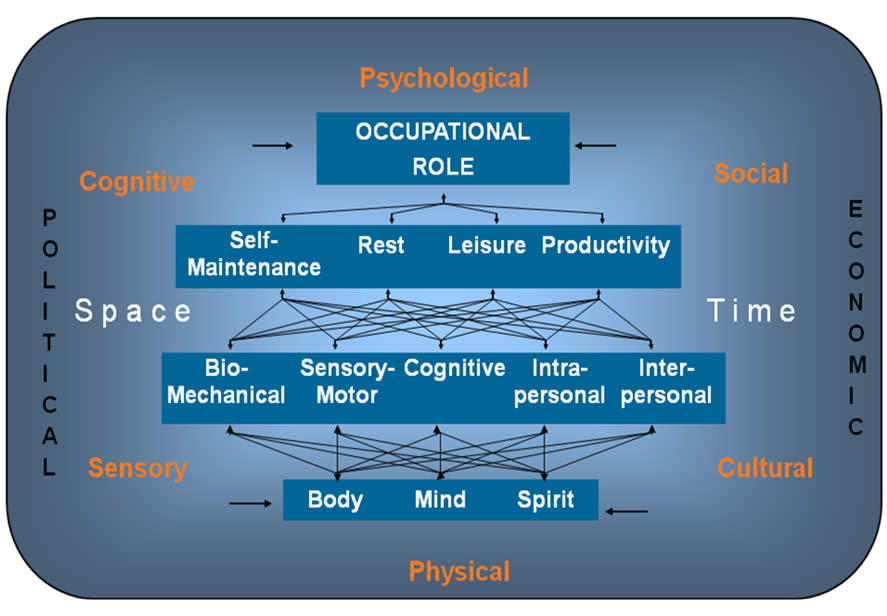
The major construct around which the Occupational Performance Model (Australia) is conceptualised is occupational performance. The central proposition in this model is that all goaloriented behaviour related to daily living is occupational in nature. Performance, as defined in this model, extends the usual notions of performance from that of motor action only to include antecedent and subsequent physical, mental and emotional processes relevant to the task performed. Performance is the ability to perceive, desire, recall, plan and carry out occupations in response to demands of the internal and/or external environments. These occupations are characterised by purposeful changes in behaviour that can be physical, cognitive or psychosocial. Occupation refers to the purposeful and meaningful engagement in roles, routines, tasks and subtasks for the purpose of self-maintenance, productivity, leisure (Reed, 1984, p.492) and rest (Llorens, 1991, p. 46; Meyer, 1922/1977, p.641).
Constructs and Structure: Construct 2
The concept of role is complex, composed of many different components and behaviours. Use of the term 'role' in this model is borrowed primarily from sociology literature (Jackson, 1972; Sarbin & Allen, 1968) and is defined as, "a set of behaviours that have some socially agreed upon functions and for which there is an accepted code of norms (Christiansen & Baum, 1991, p. 857). Roles are expressed by an automatic or deliberate assumption of behavioural patterns that are commonly associated with a specific function in society (Delbridge, 1981, p.1496). Roles function as vehicles for social involvement and productive participation and have been described as forming the nucleus of social interaction (Jackson, 1972; Vause-Earland, 1991).
Constructs and Structure: Construct 3
Occupational therapy has traditionally categorised performance of daily occupations to three areas: self-maintenance occupations, productivity/school occupations and leisure/play occupations. This model proposes a fourth area: rest occupations. Others have also recognised its importance as a dimension of occupational performance (Llorens, 1991) (Fig. 3).
Constructs and Structure: Construct 4
Accomplishment of routines and tasks in the occupational performance areas is predicated on the ability to sustain efficient physical, psychological and social function. This aspect of the model is conceptualised as forming both the component attributes of the performer as well as the components of occupational tasks. For example, there are physical, sensory-motor, cognitive, and psychosocial dimensions to any task performed. These dimensions mirror and prompt a person's various physical, sensorymotor, cognitive and psychosocial operations that are used to engage in task performance. Observation and analysis of occupational performance components can either focus on the task and sub-task components of performance (task demands analysis) or the person components of performance (behavioural task April, 1997, Monograph 1 10 analysis) and the relationship between the two. Occupational performance components are broadly classified into five component areas: biomechanical, sensory motor, cognitive, intrapersonal and interpersonal (Fig. 5).
Constructs and Structure: Construct 5
This construct acknowledges the body-mindspirit interactionist paradigm that has long been recognised as key to physical and mental health and well being (Townsend, Brintnell & Staisey, 1990) (Fig. 6).
Constructs and Structure: Construct 6
The external environment is all the conditions surrounding a person, and has been classified in various ways. This model categorises the external environment as an interactive sensoryphysical- sociocultural phenomenon (Fig. 7).