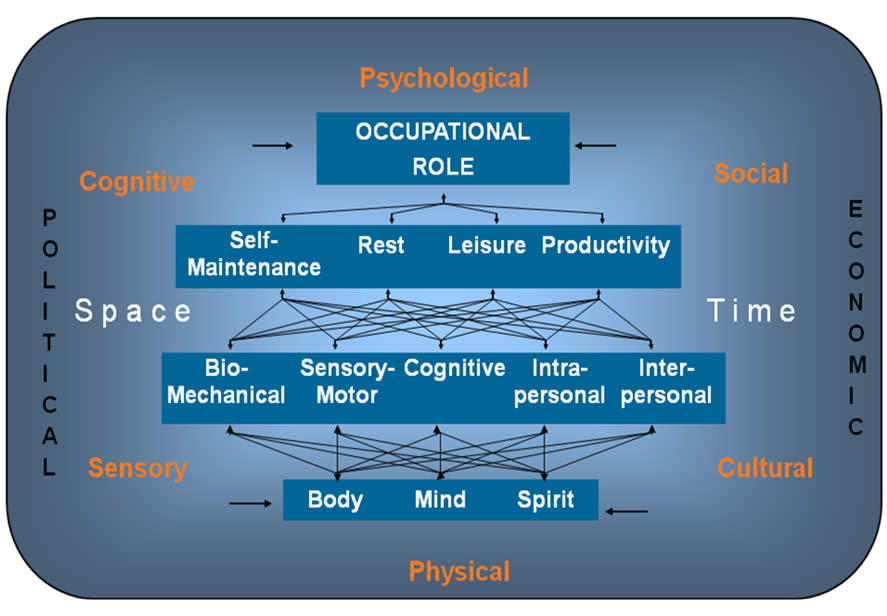
Origin
This page was downloaded from the Occupational Performance Model (Australia) [OPM(A)] website (www.occupationalperformance.com) re-launched in 2006. It contains a reprint of the seminal article that described why the OPM(A) was developed and the research process used to develop the model. The original publication details are as follows:
Chapparo, C., & Ranka, J. (1997). Towards a model of occupational performance: Model development. In C. Chapparo & J. Ranka (Eds). Occupational Performane Model (Australia): Monograph 1(pp. 24-45). Total Print Control: Sydney [now out of print].
Click on the links below to read this article in sections.
Towards a model: Introduction
The primary purpose of the undergraduate occupational therapy curriculum at The University of Sydney is to prepare students for the academic, practical and ethical demands of occupational therapy practice (School of Occupational Therapy, 1986). As part of a former College of Advanced Education, Cumberland College of Health Sciences (CCHS), the School of Occupational Therapy was required by the Higher Education Board to undergo major curriculum reviews every, five years. The goal of these reviews was to enhance quality teaching and learning, promote academic standards expected of baccalaureate degrees and to maintain curriculum relevance. In response to these curriculum reviews, the undergraduate curriculum has undergone considerable change and refinement (School of Occupational Therapy, 1975; School of Occupational Therapy, 1986).
Towards a model: Background
Undergraduate occupational therapy curriculum documents within the School of Occupational Therapy, The University of Sydney dating from 1975 to 1995 confirm the link between the structure of curriculum content and contemporary occupational therapy practice. Prior to 1975, the primary mode of practice in occupational therapy in NSW was hospital-based therapy within the Department of Health (Alexander, Keogh & Cheesman, 1980). Curriculum documents describe occupational therapy content that was largely categorised according to perceived domains of practice within the health system for groups of clients as classified by medicine; for example, orthopaedics, neurology, paediatrics, psychiatry, rehabilitation and general medicine. Occupational therapy subjects, heavily influenced by concepts of rehabilitation, focussed on occupational therapy in neurology, occupational therapy in psychiatry and occupational therapy in orthopaedics and general medicine (School of Occupational Therapy, 1975). Definitions of occupations related to disability and definitions of occupational therapy focussed on provision of services to "individuals or groups whose abilities to cope with activities of daily living were threatened or impaired by ...disability" (School of Occupational Therapy, 1975, p.2).
Towards a model: Development
The process of model development from 1986 proceeded through four stages. The methods employed to develop the model and the product of each of the four stages of development are outlined in Table 2.
Towards a model: Stage One (1989-1990)
The purpose of Stage One was to identify literature support for using occupational performance to explain occupational therapy practice.
Towards a model: Stage Two (1990-1991)
The purpose of Stage Two was 1) to determine whether the constructs as outlined in the two level model were relevant to occupational therapy practice in Australia, and 2) to discover whether there were other dimensions to occupational therapy practice that were not explained by the model.
Towards a model: Stage Four (1992-1994)
The purpose of Stage Four was 1) to continue field testing the established constructs in practice specific settings, such as paediatrics, psychiatry, spinal cord injury, community services and community-based practice, and 2) to explore the application of the model to the administration of various occupational therapy practice environments
Towards a model: Stage Three (1991-1992)
The purpose of the third stage of model development was 1) to further explore use of occupational performance terms in acute care environments where short-term stay made traditional forms of occupational therapy intervention impossible, 2) to determine whether occupational performance could be used in an area of practice that was characterised by strong adherence to a particular theoretical and practice model (eg. sensory integration) and, 3) to determine what philosophical base therapists using occupational performance held in their everyday practice.
Towards a model: Stage Five (1994-1996)
The purpose of Stage Five 1) to continue field testing the established constructs in practice specific settings, 2) to consolidate theoretical support for the constructs, and 3) to encourage others to write about the application of the model to various aspects of practice.