
Welcome to the Occupational Performance Model (Australia) website.
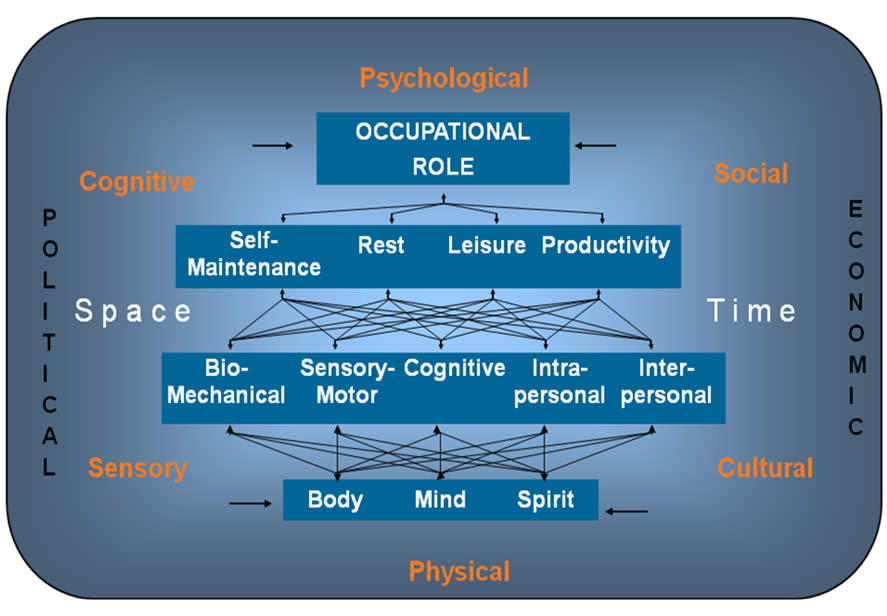
The Occupational Performance Model (Australia) [OPM(A)] is one of several models of human occupation and occupational performance developed around the world by occupational therapy theorists. This model was first conceptualized in 1986 by Dr. Christine Chapparo and Dr. Judy Ranka at the University of Sydney, Australia to illustrate the complex network of factors involved in human occupational performance, and the domain of concern of occupational therapy. It was further refined through several research phases with the assistance of colleagues and students, and is now used to explain occupational performance, to explain and guide occupational therapy practice, to frame occupational therapy research and to structure occupational therapy curricula. The inclusion of “Australia” in the name of the model reflects the fact that this model originated and was developed in Australia.
Information about the model, its development and application to practice first appeared in curriculum documents and was presented at conferences in the late 1980s and early 1990s. It first appeared in published form in 1997. The OPM(A) website was first launched in 2001 as an academic site to facilitate dissemination of information about the model in a timely manner, to make it accessible to occupational therapists around the world and to encourage dialogue among the international occupational therapy community. It was restructured in 2005, and launched in its present form in 2014.
The illustration below is a draft of the 2011 revision of the OPM(A).
| We would appreciate your feedback about the model, its use and this site, as well as, any other information that you feel might be of interest to us. |
|---|